
AI in Science Fellowship Q+A Session
16/06/2026
16:00 - 17:00This informal Q+A is for anyone interested in finding out more about the AI in Science Postdoctoral Fellowships before applying to the scheme.

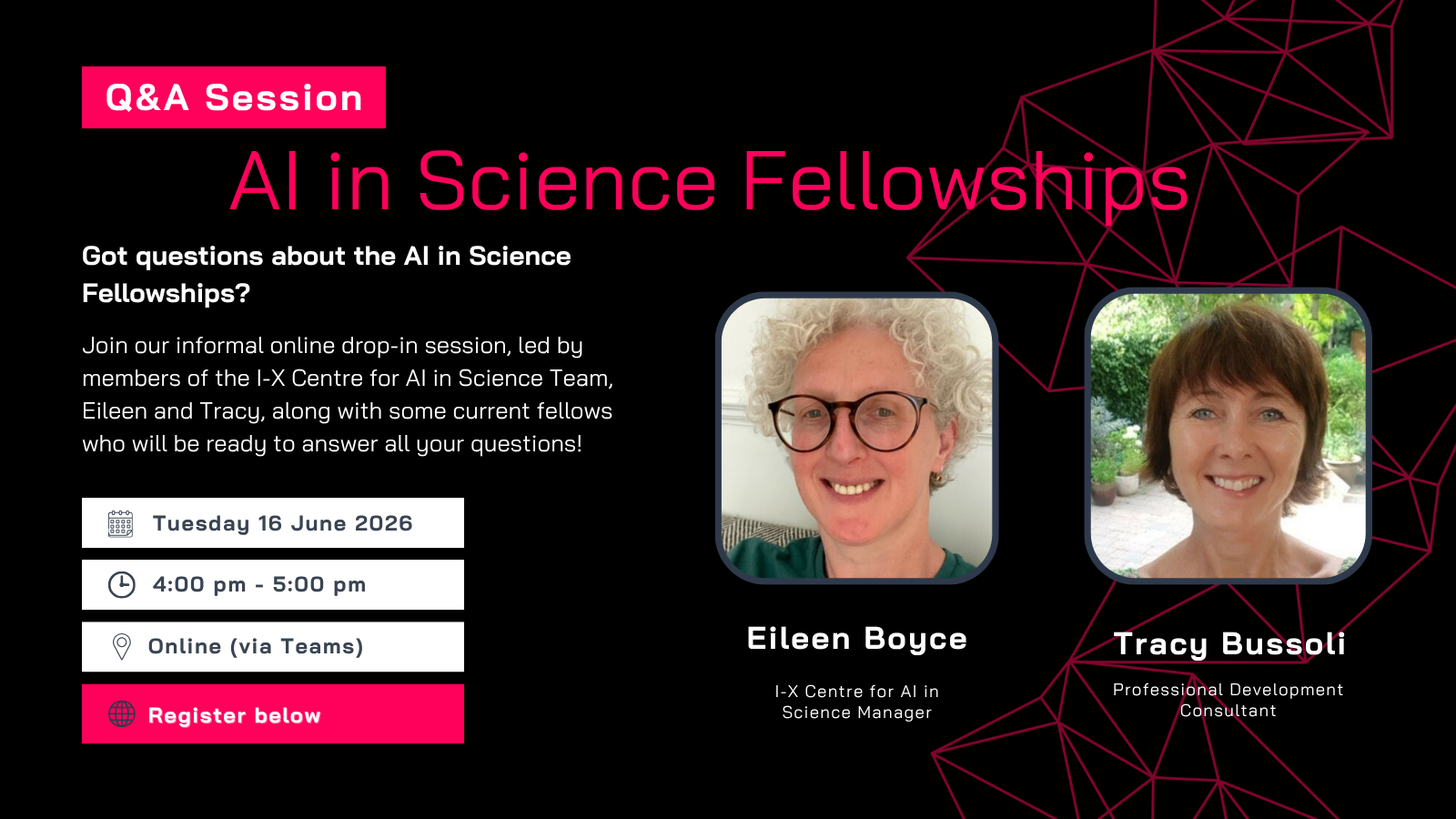
This informal Q+A is for anyone interested in finding out more about the AI in Science Postdoctoral Fellowships before applying to the scheme.

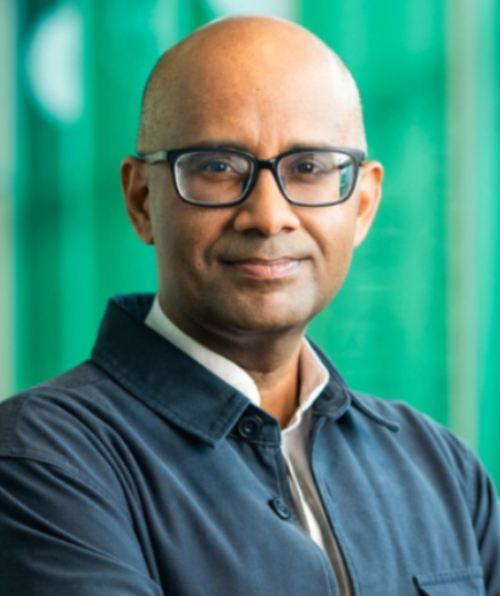
Collaboration between humans and algorithms based on the logic of relative advantage is well understood. While it produces immediate gains in productivity, it can also have long term adverse consequences for human skills.

tinyML, characterized by its low-cost, privacy-preserving, and energy-efficient architecture, represents a paradigm shift in computing. In this talk, the group will delve into key techniques and pipelines for building and deploying models on tiny edge devices, exploring the latest advancements in microcontroller technology, including multicore processors, expanded memories, and on-board TPUs and Neural Accelerators.
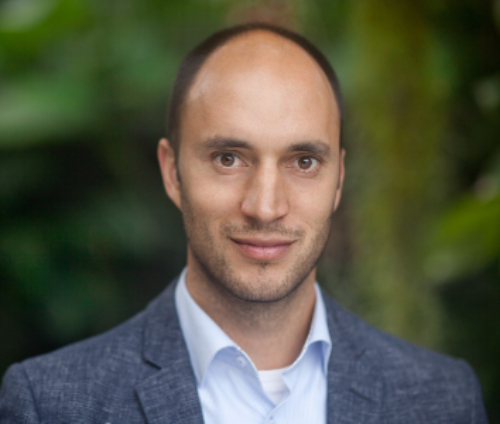
Never before has nature been at greater risk from human activities and climate change. There is therefore an urgent need to prioritise available resources in ways that provide maximum benefits to biodiversity, climate, and people. In this talk, Professor Alexandre Antonelli will outline key areas where artificial intelligence could play a substantial role in supporting on-the-ground conservation actions.

Robots possess great potential to enhance the experiences of their users. However, every individual they engage with presents a unique set of requirements and preferences. In this talk, Dr Salomons will explore the concept of personalization in human-robot interaction, by presenting several strategies by which robots can tailor their interactions to personalize for the distinct needs of each user.

Convergence science refers to transdisciplinary integrations of scientific disciplines in addressing the world’s pressing problems, in advancing science, and in rethinking how we live, work, and innovate. Diversity – of perspective, education, culture, aspiration, talent, and more – and advances in AI are key enablers of convergence science.

CO2 geological storage plays an essential role in global decarbonization and the energy transition. Predicting the transport of CO2 in subsurface formations requires the numerical simulation of multiphase flow through porous media.

